



Recently, Professor Liao Zhengyin from the Cancer Center of West China Hospital, Sichuan University, successfully performed a Wknife (irreversible electroporation) ablation under local anesthesia for a patient with hepatic malignancy at Huanya Hospital. This marks the first liver cancer ablation procedure using Wknife in Southwest China since its market introduction.
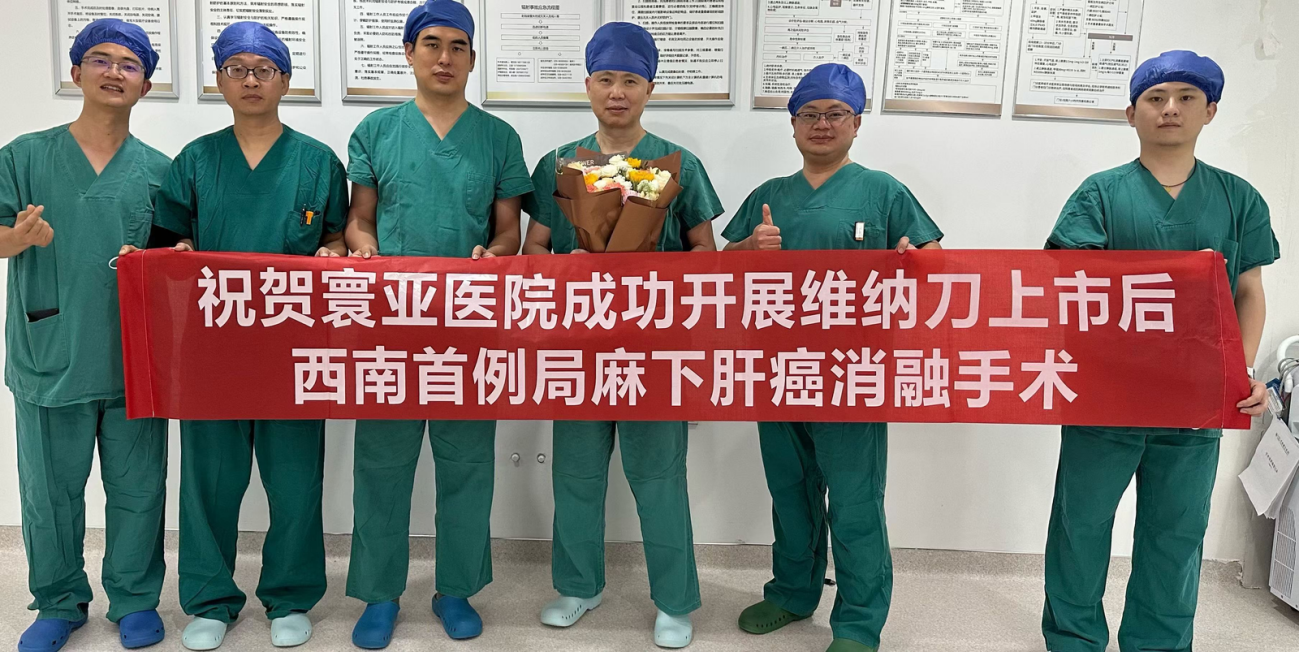
The patient faced a treatment deadlock – the tumor was ineligible for embolization, surgical resection, thermal ablation, or general anesthesia
The patient is a 62 year old male diagnosed with liver cancer several years ago. The primary lesion in the left lobe was large but regressed following transarterial interventional therapy combined with targeted therapy, resulting in long term stable disease control. However, recent follow up revealed a new lesion in the right lobe: contrast enhanced CT showed an exophytic, round to ovoid mass in the anterior inferior segment of the right hepatic lobe, measuring approximately 3.4 × 3.5 cm in maximum cross section. The lesion exhibited typical enhancement patterns of hepatocellular carcinoma, with slight enlargement compared to CT findings one year prior. The tumor is exophytic and closely abuts the stomach, duodenum, colon, and inferior vena cava.
Moreover, the patient presents with challenging baseline conditions: he has long standing cirrhosis with a history of two prior episodes of hepatic encephalopathy. Liver function has deteriorated to decompensated status (Child Pugh Class C), with portal hypertension and splenomegaly. Under these circumstances, general anesthesia would carry a significant risk of precipitating hepatic encephalopathy and coma. In essence: embolization offers limited efficacy; the tumor location precludes surgical resection; thermal ablation is contraindicated due to proximity to major vessels; and general anesthesia is considered too high-risk.
Wknife Breakthrough: Bipolar Single Needle, Total Local Anesthesia.
Faced with this challenging situation, Professor Liao Zhengyin chose the Wknife, developed by Hangzhou Winonco Medical Technology Co., Ltd. This product utilizes non thermal ablation technology, requires no general anesthesia or muscle relaxants, and can be performed under local anesthesia – precisely matching the patient’s extremely limited treatment options.
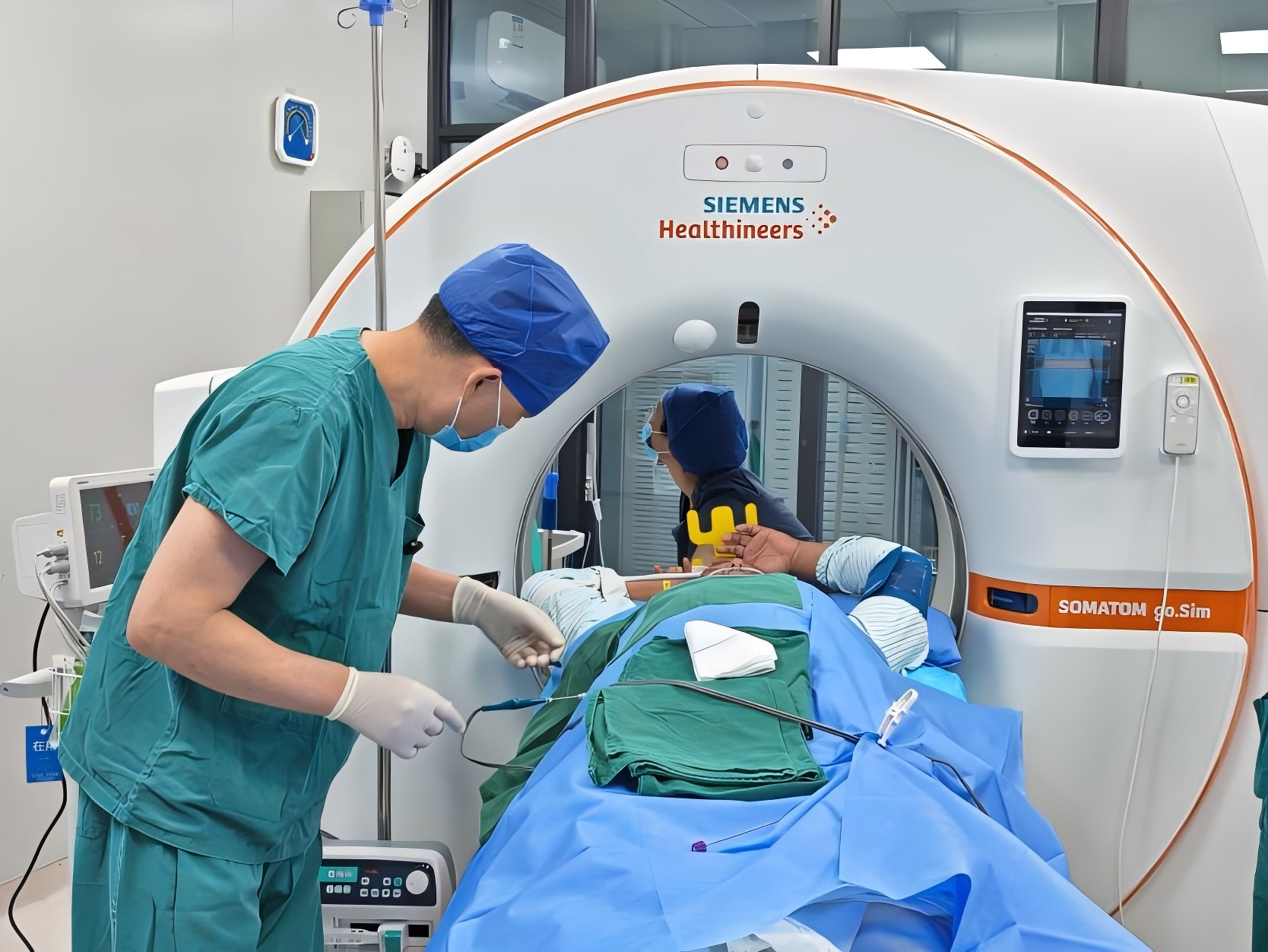
This procedure was performed under CT guidance. After target localization, Professor Liao Zhengyin used a single bipolar ablation needle under local anesthesia to precisely puncture and ablate the target lesion. Throughout pulse delivery, the patient experienced no muscle contractions, remained hemodynamically stable, and stayed fully awake. The entire procedure took less than one hour. Intraoperative imaging demonstrated complete coverage of the lesion by the ablation zone, with satisfactory ablation results meeting clinical expectations.
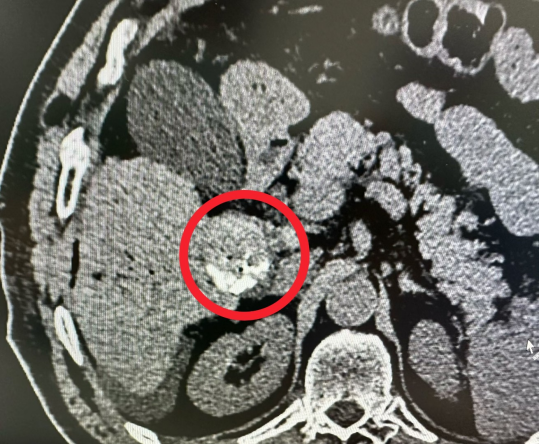
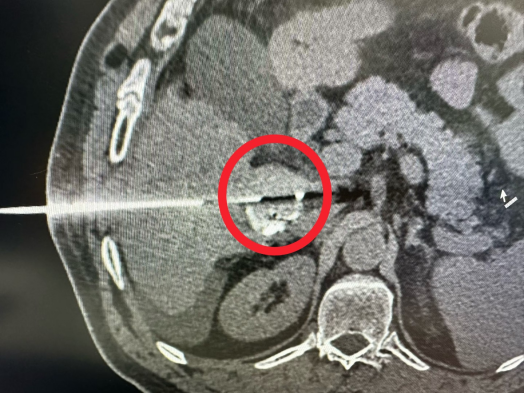
From the operator‘s perspective, the simplicity of this procedure was particularly striking: no repeated calculations for parallel multi needle placement, no cumbersome muscle relaxant management, total local anesthesia throughout – simply place a single bipolar needle, deliver the pulses, confirm ablation coverage via imaging, and the entire high risk ablation workflow is compressed to its shortest possible duration, with the surgery completed in a remarkably short time.
Surgeon‘s comment: Lowering the barrier, setting the benchmark.
Professor Liao remarked with high praise: “With just a single bipolar needle, the domestically developed Wknife successfully completed the ablation of a complex liver cancer in a challenging anatomical location under local anesthesia, with no muscle contractions throughout the entire procedure. Not only did it achieve excellent therapeutic efficacy, but it also significantly lowered the operational threshold for the procedure. As the first case of liver cancer ablation using Wknife under local anesthesia in Southwest China, the procedural simplicity demonstrated by Wknife not only establishes a new clinical benchmark but also lays a solid foundation for the rapid adoption and dissemination of this technology across the region, ultimately benefiting a larger number of cancer patients.”
Clinical value: Opening a new era for NanoKnife technology.
The academic community has long recognized the advantages of irreversible electroporation (IRE) technology: non thermal ablation, well defined ablation margins, preservation of critical structures such as blood vessels and bile ducts, and favorable immunomodulatory effects. Its clinical value in treating tumors in high risk anatomical locations is beyond question – yet its adoption has remained limited, primarily due to the steep technical demands.
Difficult needle placement: Conventional IRE systems like NanoKnife require precise parallel placement of multiple electrodes, with stringent requirements on needle spacing and insertion depth. Nationwide, fewer than ten experts are capable of performing this procedure at a master level.
Difficult anesthesia: The procedure must be performed under general anesthesia with deep neuromuscular blockade, and requires ECG synchronization – a combination that discourages many departments and physicians. No matter how promising the therapy, if few can perform it and few dare to offer it, the technology remains confined to publications and a handful of centers.
Difficult for patients: Patients face the risks associated with general anesthesia and multi needle placement, along with high treatment costs.
Recently approved for market, Wknife (developed by Winonco) employs broadband synergistic pulse technology to suppress muscle contractions and simplifies the multi needle configuration into a single bipolar needle – enabling the entire ablation to be completed under local anesthesia with just one needle, transforming a notoriously difficult procedure into one that is more accessible and easier to master.
This procedure successfully broke through the limitation that advanced liver cancer patients with poor liver function could not tolerate ablation, fully demonstrating the technical advantages of Wknife. It marks the beginning of a new era in irreversible electroporation tumor ablation – characterized by local anesthesia and single needle operation.
INTRODUCTION

Professor Liao Zhengyin, West China Hospital, Sichuan University
*Former Chief Physician and Professor at the Cancer Center of West China Hospital, Sichuan University
*M.D. from Sichuan University; Postdoctoral Fellow in Interventional Therapy at the Chinese PLA General Hospital; Master's Supervisor
*Senior Visiting Scholar in Interventional Medicine at Johns Hopkins Hospital (USA), University of Washington Medical Center (USA), and Singapore General Hospital (Singapore)
*Member of the Interventional Committee, Radioparticle Committee, and Ablation Therapy Committee of the Chinese Medical Doctor Association
*Member of the 4th and 5th Pain Society of the Chinese Medical Association, Deputy Leader of the Cancer Pain Group
*Chairman of the Interventional Medicine Committee of the Sichuan Medical Association
*Chairman of the Tumor Minimally Invasive Therapy Committee of the Sichuan Anti-Cancer Association
*Member of the Tumor Minimally Invasive Therapy Committee of the China Anti-Cancer Association
*Vice Chairman of the Pain Committee of the Sichuan Medical Association
*Academic Leader of the Sichuan Provincial Health Commission
*Editorial Board Member of Chinese Journal of Interventional Imaging and Therapy and Chinese Journal of Pain Medicine
About Winonco
Hangzhou Winonco Medical Technology Co., Ltd. is a national high-tech enterprise focused on the field of minimally invasive tumor ablation. Driven by clinical needs, the company is committed to advancing innovative medical technology R&D. At its core is a proprietary high voltage pulsed electric field irreversible electroporation (IRE) technology, integrated into a multi physics, multi modal platform to develop internationally leading minimally invasive tumor ablation solutions.
Founded by overseas returnees from Europe and the United States and nationally recognized scientists, the company boasts a high level interdisciplinary R&D team spanning electrical engineering, biology, medicine, and clinical disciplines. With its world leading pulsed field ablation platform and clinically oriented system solutions, the company has been awarded key projects from the National Natural Science Foundation of China (NSFC), as well as multiple national key R&D programs and NSFC grants. Winonco holds full independent intellectual property rights in IRE technology, with over 200 domestic and international patent applications filed (including 18 PCT patents), and has twice been designated as an Innovative Medical Device. The company continues to drive technological innovation and clinical translation, delivering safer, more minimally invasive, and more accessible Chinese solutions for patients worldwide.