Working Principle
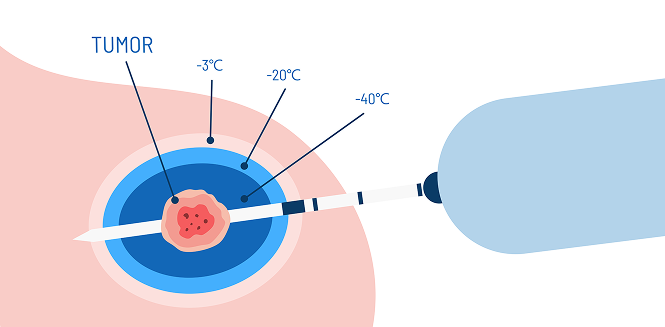
Based on the Joule-Thomson effect: When a gas passes through a narrow orifice from a region of higher pressure into a region of lower pressure, it undergoes throttling. Most gases experience a temperature drop after throttling, such as argon and nitrogen.
Detailed Principle
Room-temperature high-pressure gas undergoes heat exchange in the system's pre-cooling unit, transforming into low-temperature high-pressure gas. Upon passing through the micro-aperture of the disposable cryoablation needle, it rapidly expands inside the tip, generating a cooling effect and releasing cold energy to freeze the target tissue. Subsequently, the gas returns to the system after exchanging heat again with the high-pressure gas in the heat exchanger. During this process, the low-pressure low-temperature gas passes through the heat exchanger, exchanging heat with the incoming gas to lower its temperature, thereby further reducing the temperature of the gas after throttling and enhancing the refrigeration effect.